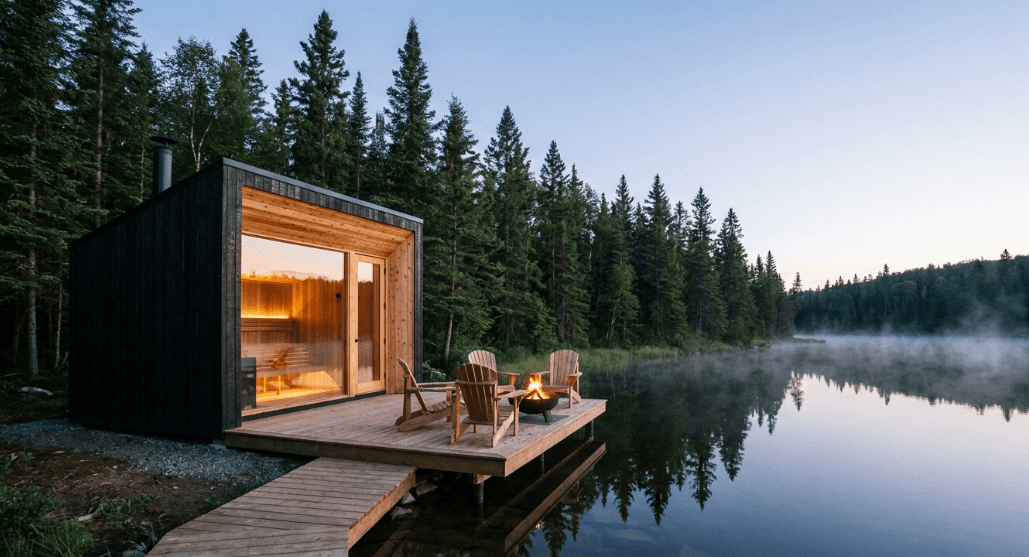
The unit itself is only part of the total. A realistic budget adds electrical work for an electric heater, or a chimney kit for wood-fired, a foundation pad, and delivery to wherever the sauna will actually sit. For a straightforward two-person electric barrel unit with easy site access, total cost typically lands modestly above the listed unit price. A larger cabin, a wood-fired heater, or a yard with tricky access pushes the total meaningfully higher.
What Does the Sauna Unit Itself Cost?
Unit price scales with three things: shape (barrel generally costs less than cabin for the same capacity), wood species (cedar costs more than heat-treated hemlock or spruce), and assembly level (a DIY kit costs less than a pre-assembled unit). A budget two-person barrel sauna kit sits at the low end of the market. A four to six-person pre-assembled cabin in premium cedar sits considerably higher. Heater type is usually priced separately or as an add-on tier, with wood-fired heaters typically costing more than comparable electric units.
What Does the Electrical Work Add?
Electric heaters need a dedicated 240V circuit, which means an electrician pulling new wire from the main panel to the sauna’s location, plus a weatherproof disconnect box outside the unit. Cost depends heavily on distance: a sauna placed near the house with an accessible panel is far cheaper to wire than one at the back of a large lot that needs a trenched underground run. Getting a quote from a licensed electrician before finalizing the sauna’s placement is worth doing early, since moving the spot ten feet closer to the panel can meaningfully change this line item.
What Does a Wood-Fired Chimney Kit Cost Instead?
Skipping electrical work in favor of a wood-fired heater trades one cost for another. A proper insulated chimney kit, roof flashing, and the required clearances from combustible materials add to the installed price, and in some jurisdictions a permit and inspection are required for the chimney specifically. Wood-fired heaters also cost more to purchase than a comparable electric model, so the savings on electrical labor are partially offset by higher costs elsewhere.
What Does the Foundation Add to the Budget?
A compacted gravel pad is the least expensive foundation option and works for most barrel and smaller cabin units on ground that already drains reasonably well. A paver base costs more but looks more finished and handles uneven ground better. A poured concrete slab is the most expensive option but is the standard choice for heavier cabin units or anywhere frost heave is a real concern. Skipping a proper foundation to save money is the single most common budget mistake, since a sauna sitting directly on soil or grass will trap moisture against the base boards and shorten the structure’s life significantly.
What Does Delivery Actually Cost?
A flat-packed DIY kit ships in boxes that a standard delivery truck handles easily, keeping this cost low. A pre-assembled or panelized cabin is heavier and bulkier, and if a backyard has narrow gate access, a steep driveway, or no direct path from the street, a crane lift or specialized rigging may be required, which adds noticeably to the total. It is worth walking the actual delivery path from the street to the install site before ordering a pre-built unit, not after the truck shows up and cannot get through the gate.
How Do You Compare the Full Cost Across Options?
Because unit price alone tells only part of the story, it helps to look at what a given listing actually includes: does it come with the heater, or is that priced separately? Does the seller offer delivery, or is that arranged independently? Browsing a few sources side by side, including the the SweatDecks outdoor saunas collection, alongside other retailers gives a reasonable sense of where a given unit’s total, all-in price falls relative to the broader market before committing to a foundation and electrical plan built around it.
Is the Total Cost Worth It?
Cost only makes sense in context of use, and the research on regular sauna bathing gives a genuine reason to view this as more than a backyard luxury item. Long-term cohort studies have associated frequent sauna use with lower rates of fatal cardiovascular events and broader health benefits over years of consistent use. That does not make any single unit worth an unlimited budget, but it does mean the honest comparison is not “sauna versus no expense” but “sauna versus another form of stress relief and recovery,” most of which carry ongoing costs of their own.
Where Can You Trim Costs Without Cutting Corners?
The most defensible places to save are size (buy for real weekly use, not peak gatherings), wood species (heat-treated hemlock instead of cedar, if budget matters more than the last bit of natural rot resistance), and assembly (a DIY kit if you have a free weekend and basic tools). The places not to cut corners are the foundation and the electrical work, both of which affect safety and the structure’s lifespan far more than they affect the sticker price.
Frequently Asked Questions
What is the total cost of an outdoor sauna including installation?
Beyond the unit price, expect to add electrical work, a foundation pad, and delivery, which together commonly add a meaningful percentage on top of the sticker price. A budget two-person electric barrel sauna with straightforward site access lands at the lower end of that range; a larger cabin with a wood-fired heater and difficult access lands at the higher end.
Is electrical work always required for an outdoor sauna?
Only electric heaters require it. A dedicated 240V circuit run from the main panel to the sauna location is standard for most residential electric heaters, and the labor cost depends heavily on the distance and whether trenching is needed.
Do I need a permit to install an outdoor sauna?
Many jurisdictions require an electrical permit for the circuit and sometimes a building permit depending on the structure’s size and whether it is considered a permanent accessory building. Rules vary by city and county, so checking with the local building department before installation avoids costly rework.
What foundation is cheapest for an outdoor sauna?
A compacted gravel pad is typically the least expensive option that still provides adequate drainage and stability, cheaper than a poured concrete slab or paver base. It works well for lighter barrel-style units on relatively flat, well-draining ground.
Does delivery cost more for a pre-assembled outdoor sauna?
Yes, generally. A pre-assembled or panelized unit is heavier and bulkier to move than a flat-packed DIY kit, and tight backyard access, fences, or steep grades can require a crane or specialized equipment that adds to the delivery cost.
References
- Kunutsor, S.K., et al. “Association between sauna bathing and fatal cardiovascular and all-cause mortality events.” JAMA Internal Medicine, 2015. https://pubmed.ncbi.nlm.nih.gov/25705824/
- Laukkanen, T., et al. “Joint associations of sauna bathing and cardiorespiratory fitness on cardiovascular and all-cause mortality risk.” Annals of Medicine, 2018. https://pubmed.ncbi.nlm.nih.gov/28972808/
- Laukkanen, T., et al. “Cardiovascular and Other Health Benefits of Sauna Bathing: A Review of the Evidence.” Mayo Clinic Proceedings, 2018. https://pubmed.ncbi.nlm.nih.gov/30077204/